
How We Got Here: The Story Behind Swim Open Waters
- Sidney & Angela
- Jul 9
- 4 min read
Every coaching partnership has an origin story. Ours begins, as so many good things do, at the water's edge.
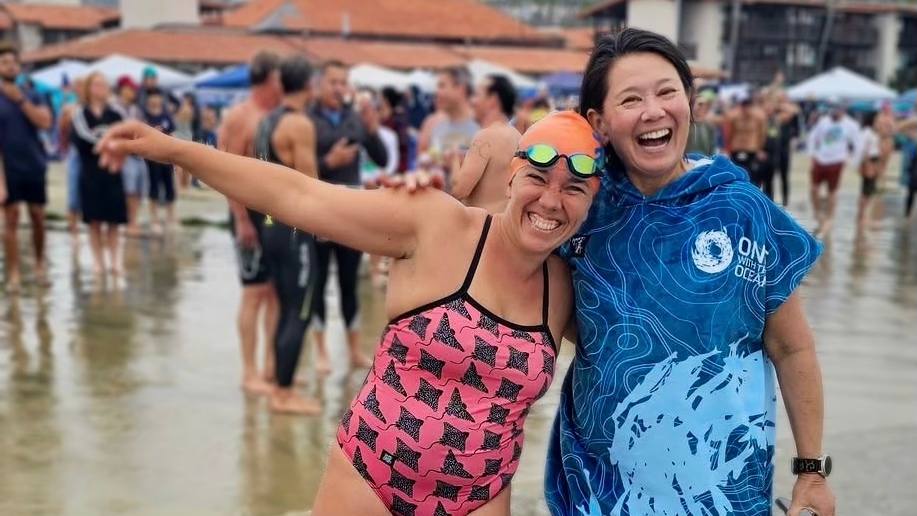
But if you knew us both before this, you might not have predicted we'd end up here together. Sidney Russell has been at home in the ocean since childhood. Angela Lee didn't swim her first open water stroke until she was 47. That gap in experience, rather than being a disadvantage, turned out to be exactly what makes this partnership work.
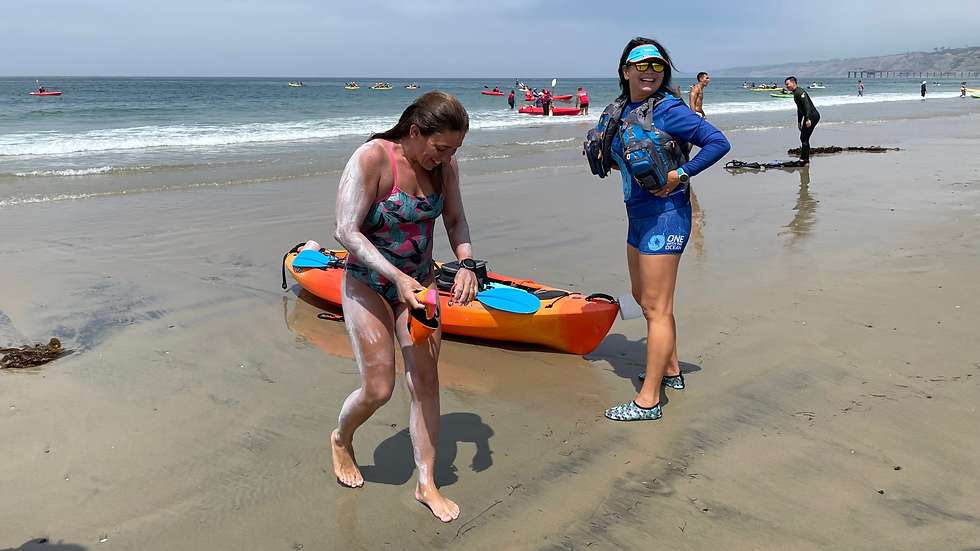
In 2021, Angela drove from Los Angeles to La Jolla with a kayak and a mission. She was there to paddle support for an eight-hour training swim, the kind of long, grinding effort that serves as a dress rehearsal for a Catalina Channel crossing. The swimmer she was there to support was Sidney, a San Diego-based coach who had been volunteering with One With the Ocean, a nonprofit organization where Angela served on the board. They had mutual friends, and Angela had heard through the community grapevine that Sidney was preparing for her first Catalina attempt. Angela wanted to give back to someone who had been quietly giving so much to the open water community. So she loaded up her car and drove south.
That day on the water was the beginning of everything.
Shortly after, Angela served as an official observer for the Catalina Channel Swimming Federation on Sidney's first Catalina Channel crossing, a role that put her right there alongside Sidney during one of the most significant swims of her life. What started as community gratitude became genuine friendship.
The roles we play for each other have never been strictly one-directional, and they have never been simple. Sidney is the swimmer who grew up in the ocean, competed in age-group through high school, and has been refining her technique for decades. Angela came to open water swimming as an adult triathlete who spent years in survival mode during race swims before falling in love with the ocean during the pandemic. She learned to swim largely on her own, developing habits that got the job done but were never going to win any efficiency awards. Those two very different relationships with the water are, it turns out, a genuine asset when it comes to coaching.
While Sidney brings deep technical expertise to the partnership, Angela has logged hundreds of hours on the kayak watching Sidney and dozens of other swimmers move through the water. From that vantage point, she has marveled at the efficiency of Sidney's stroke and her extraordinary breath control. Sidney swims with an ease that allows her to breathe comfortably every four to six strokes, a level of relaxation and technique that most swimmers spend years chasing. Angela was Sidney's main kayak support through marathon swim training and her double channel crossings, and served as crew chief for Sidney's English Channel crossing in July 2024. While Sidney writes her own training plans, she turns to Angela as a sounding board when life inevitably gets in the way and adjustments need to be made.
In 2022, when Angela decided to attempt marathon swimming herself, Sidney became her coach. Sidney guided Angela through her Around Coronado Island swim in April 2023 and her Anacapa Island to Oxnard crossing of the Santa Barbara Channel in July 2023. Both swims got done, but both were marked by significant stomach issues. Rather than accept that as her story, Angela dove into the research, eventually earning her NASM Nutrition and Sports Nutrition coaching certifications and applying that knowledge to endurance fueling, particularly for athletes with sensitive stomachs.
Those stomach struggles also sparked a bigger conversation, and that conversation kept growing. When Angela decided to return to marathon swimming after a couple of years away, she and Sidney started looking honestly at her self-taught stroke. What they found was instructive in ways that went beyond Angela's swimming. Because Angela came to the sport as an adult with no formal swim background, she had muscular gaps that many lifelong swimmers simply don't have. Certain drills that are standard corrective tools were difficult for Angela to execute properly, not because she wasn't trying, but because the supporting musculature wasn't there yet. That problem became an opportunity. Working together, Sidney and Angela began developing on-land strength and mobility routines specifically designed to build the foundation that would allow in-water drills to actually work. The coach who has swum her whole life and the athlete who started at 47 turned out to be exactly the right team to solve that puzzle.
That work became the seed of The Form Fix Project, a structured approach to stroke correction that pairs on-land preparation with in-water drills, and we're currently building it out with Angela as the first client.
The Form Fix Project also led us down an unexpected research rabbit hole. Sidney believes her breath control is rooted in her childhood as a competitive gymnast, where managing breath and body tension under pressure was just part of the sport. When we started looking for ways to teach that kind of control to other swimmers, we found ourselves in a surprising place: the world of oboe players. The specific demands of breath management in double-reed instruments offered a framework for thinking about breath control in swimming that neither of us had come across before. We used that theory to develop a companion breath control exercise plan that sits alongside the stroke work.
In 2026, Angela officially joined Sidney as a partner in Swim Open Waters, bringing together everything they had built alongside each other over the previous five years into one shared home.
At the end of the day, we're a partnership built on trust, mutual respect, and a shared belief that it's never too late to get better. One of us has been swimming since she could barely see over the edge of a pool. The other is still figuring it out. Which means we understand this sport from angles that most coaching teams don't. We've taken turns supporting each other, learning from each other, and pushing each other, sometimes from the water, sometimes from the kayak, and sometimes just from a phone call when a training week goes sideways.
We're glad you're here. There's a lot more to come.


Comments